Wednesday, 28 April 2010

Leadership

What is Leadership?

Within a business it can become difficult to differentiate between Leadership and Management so what is the difference?

Leadership is defined as “A relationship through which one person influences the behaviour or actions of other people (Mullins 2007). A leader within a business will work with employees on a close scale, have a working relationship with the employees and ultimately have the ability to influence what they do leading them in their work and motivating them. Leaders need to have a number of different skills to make this possible as without such skills they will not be able to motivate, encourage people to work, and improve sectors.

How is this different to Management?

Management with in a business can be seen as “The structures and processes involved in directing an organisation towards the achievement of its objectives” (Worthington & Britton 2009). This is different to leadership as a manager is a person who is there to get what they need done whether that means by exerting force on employees or granting them flexibility and freedom to complete the work, compared to a leader a manager can be seen as a middle man between the different levels of the business who implement policy.

The ‘managerial grid’ what is it?
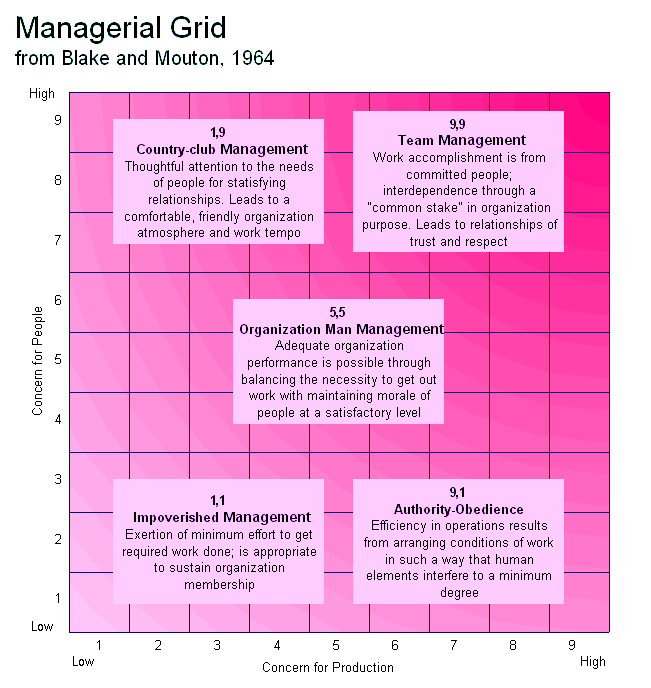


(Blake, R. Mouton, J S. 1964)

This grid is used to look evaluate management styles, it compares the two aspects of Concern for production which looks at how the manager tries to make sure production is at a maximum resulting in larger profits for the business and concern for people which looks at whether the manager is placing more emphasis on the needs of the employees working on the product. The higher the score the more effective a manager is deemed to be, for example if a manager scored 1,1 this would mean that they have little concern for the people working on the product as well as little concern over how the product turns out whereas a score of 9,9 would show the manager really cares and takes a interest in both areas maximising production and motivation.

Such a strong leader?

One leading from history that has shown an obvious strong leadership streak (although not used positively) is Russia Stalin, who used his unique skills advancing from the role of general sectary in the Bolshevik party and being generally unknown to a incredibly strong leader known worldwide. By using his skills Stalin won over support by performing speeches to the public, bombarding streets with propaganda promoting communism and a ‘better life’ under it, he made sure he looked at all the different groups within Russia from the peasants to the rich promising them each something they wanted.

Conclusion

Management and leadership play a very close role within businesses and need to have a good working environment to make sure that work is completed and employees remain motivated and happy and ultimately produce more work.

References

Brassington, F. Pettitt, S. (2007) Essentials of marketing. 2nd ed. Essex: Pearsons Education Limited

Blake, R. Mouton, J S. The managerial grid. 5th ed. Gulf Publishing. Houston, 1964

Mullins, L. (2007) Management and Organisational Behaviour. 8th edition. Essex: Pearson Education Limited

Organisation Culture.

“Culture can be described as the personality of the society within which an individual lives” (Brassington & Pettitt 2007). This can also be seen in the environment of a business as people will bring their views beliefs and feelings into work with them.

All businesses have a variety of different cultures within them, The Royal Marsden Hospital has its own different cultural aspects such as uniforms, and each employee has their own uniform which denominated what department they are working for making it easy for people within the hospital to identify employees as well as keeping the hospital hygienic as staff have specific clothes that they must wear when performing different roles it also helps identify employees from different departments. By doing this the Royal Marsden brings a team feeling to the work place as each individual can be identified when working in a group and their role is easily known to anyone working in the team.

Another visible aspect of culture within the Royal Marsden is how everyone is able to work together instantly without question or dragging their heels because they may not know the other person, this happens because they all share the want to help people in the hospital and they enjoy and believe in what they are working for.

Task culture

This type of culture can mostly be seen in project based companies such as building or landscaping businesses the business is presented with a problem and then has to solve it, team working is paramount to success and the task in hand is key rather than individual work giving a lot of flexibility and freedom as well as allowing strong culture links.

Power culture

In organisations with power culture the decisions mainly come from powerful central figures within the business an example of a business like this is a hairdresser there are few rules and regulations in place which means that culture will thrive and be strong in this type of business, decisions can be made fast and effectively as personal communications are easier due to the size of the business and lack of rules.

Role culture

Role culture is typically seen in bureaucratic organisations; the majority of the power in this sector is based on a hierarchy, so the majority of the decisions will be made at the top of the hierarchy and then delegated down to the lower levels. Each sector of the business works together to complete effectively and efficiently, employees have their own job description to work towards making the work system flow fluidly. All of the employees have rules and regulations that they must follow when completing their work. Due to the harsh rules and regulations that need to be followed their will be little room for culture.

Person culture

This is where individual is the most important factor with in the business, the sole responsibility and actions of the business exist to serve the interests of those within it, staff are given large amounts of freedom and flexibility allowing skills to flourish, this can mainly be seen in businesses such as Pointers or Carpenters.

Problems with the way culture is classified.

“Culture manifests itself through the built environment, art, language, literature, music, prevalent beliefs and value systems” (Brassington & Pettitt 2007). Due to this fact many people cannot be classified in to one of Handy’s four groups resulting in many different types of culture in each business environment.

Culture in practice: Marks and Spencer’s

http://www.marksandspencer.com/

Marks and Spencer’s displays a large understanding into their employee’s cultural needs, and aim to treat their employees fairly and give them the best possible options in the future to advance their careers. One way Marks and Spencer’s dose this is by training their employees as it creates a equal feeling between all employees as they all have the same options to succeed no matter what level they are at. Another way is by giving staff rewards and benefits such as a large discount and flexible working hours.

Conclusion

Due to the vast amount of factors that influence culture it is extremely hard for a business to have one sole type of culture like Handy suggested but is more likely that there are many different groups of culture within a business’s employees which creates a positive working environment.

References

Brassington, F. Pettitt, S. (2007) Essentials of marketing. 2nd ed. Essex: Pearsons Education Limited

Tuesday, 27 April 2010

Improving staff performance.

Improving staff performance

There are two types of motivational theory’s that give people the driving force to succeed. The first type is Content theory. This motivation theory assumes that individuals have needs that they need peruse, an example of this type of motivation is Maslow’s hierarchy of needs, there are five levels biological and physiological needs, safety needs, belongingness, esteem needs and self actualisation. For people to reach their goals they must work their way up the triangle this content theory assumes that people need to meet each level before they can move on and ultimately succeed in their goals.

Whereas process theories work on the bases that employees need to be rewarded to make them work hard and remain motivated an example of this is Goal theory. “Goals guide people’s responses and actions. Goals direct work behaviour and performance” (Mullins 2007). Another example of process theory is Expectancy theory this is when people put the effort in because they expect to receive a reward for their work; the behaviour of the work is mainly determined by how much they want the reward.

How do businesses motivate their staff?

One business that has managed to highly motivate their staff is Nandos, they have been awarded three stars in the Best Companies Accreditation 2010 scheme and been described as one of the top 10 employers to work for.
To motivate their staff Nando’s try to bring aspects of their employees into their restaurants, this makes employees more motivated to work as they really do feel like part of a family at work and are in a happy environment with a positive atmosphere.”Our aim is not to be just another chain of restaurant. We want each Nando’s restaurant to be individual” (Nando’s 2009)

Nando’s mainly uses Content theory when motivating their staff, as they believe that their staff are not just motivated by rewards but motivated by doing their jobs to the best of their abilities and want to progress at work rather than just turn up and be happy doing the same monotonous job with no drive to succeed. As well as this Nando’s uses process theories to reward their staff for their hard work motivation and dedication to the business, for example each employee is given a meal after 4 hours of work. As well as this team meetings take place where individual employees are praised for their work.

Another business that has motivated staff is Tesco, who use process theories to maintain staff motivation one of the rewards “Tesco is offering all 268,065 of their employees is a day’s paid leave to use as their own personal day over the Christmas period” (Mckeever 2009). As well as this staff are given thank you vouchers depending on how many years they have been working at the shop. Another way they reward their staff is by offering £92 million worth of free shares as part of their success scheme

One area that Tesco has not seemed to spend much time is on content theories, by having a work force that are mainly working for rewards could result in Tesco having to spend more money to encourage staff to work as they will take the opinion that “why should I work and spend extra time on something when I am not getting anything for it”.

So what?

For a business to make sure that they have a motivated and dedicated workforce they need to look and both theories to keep employees working effectively and efficiently as some employees may be more motivated by rewards that moving up the career table. This is why smaller companies may fail to keep its staff motivated as they will not have the same resources and capital to invest in motivational schemes.


References
Mullins, L. (2007) Management and Organisational Behaviour. 8th edition. Essex: Pearson Education Limited

Harmer, J. (2010) Nando’s scoops prize [online]. Available from: http://www.caterersearch.com/Articles/2010/02/10/332167/Nandos-scoops-three-stars-in-the-Best-Companies-Accreditation-2010.htm [Accessed 25 April 2010]

Nandos (2009) The Nando’s story [online]. Available from: http://www.nandos.co.uk/default/EXP21/Service.html#nandos=PM-cat_ABS8_tcat_EXP+DCMD-FAM_default_subcat_ABS8 [Accessed 26 April 2010]

McKeever, K. (2009) Tesco [online]. Available from: http://www.employeebenefits.co.uk/item/8169/23/5/3?nl=WN [Accessed 25 April 2010]

Monday, 12 October 2009

Motivation

Motivation is a factor that affects everyone, whether it is in business or just day to day life. There are many theory’s on motivation cycles and how people can achieve things, one of these theory’s that I believe affects me the most is Maslow, who believed there were 5 stages in the motivation cycle and each stage must be achieved before someone can succeed and then move on to something else Maslow’s motivation diagram looks like this

This diagram shows the different levels within Maslow’s hierarchy of needs and what is needed to full-fill that level on the hierarchy, for someone who is going for a promotion they will need to work their way up the levels to reach the top and that promotion, Maslow believed that people will always want more (Mullins 2007) meaning that his hierarchy is a constant cycle.

The first level is Basic needs which are needed for survival and to allow people to perform their daily tasks. The second tier of the hierarchy looks at Safety needs, people who reach this level of the hierarchy look need to have financial security and personal security they need to know that they will be earning enough money to be able to live comfortably; they also need to know that they are safe within their work place and that they can go to work each day and not worry about health and safety or work in poor conditions. The third level of the pyramid is Social; people at this level will have a working relationship with their work colleagues and have friends, making people feel a part of the business and valued. The forth layer is Esteem, at this level of the hierarchy people will expect to have respect within their work place resulting in that person feeling as if they are accepted and needed within the business and not just a pencil pusher. The last layer of the pyramid is Self-actualisation to reach this end goal people must work their way up the hierarchy, to become fully motivated. The last layer is the final need before the person reaches their goal and it is at this point when they are the most motivated to succeed, and once they have the cycle starts again.

I was motivated to do a degree in Business Management for three reasons, the first reason I wanted to do this course was because I received good GCSG and A level results, and really enjoyed learning about business in my high school, as it was something new and exciting and I enjoyed looking into different parts of businesses and how they work together as well as this it was a subject that I go to chose to do unlike English or Maths which I had been made to study from the beginning of my education and had no choice but to take the lessons, this can relate back to Maslow’s hierarchy as I was motivated to do Business studies I wanted to achieve good grades and have a good understanding of the subject so I got to the top of the hierarchy unlike in English I was not motivated so I was stuck on the third tier of the hierarchy as I was in a safe environment, I had basic amenities, friends, and I felt I was a part of the class but I did not strive to get to the next level.

The second reason I chose to do Business Management was top get a high paid job that I enjoy doing, so I will be able to live a comfortable and happy lifestyle. Lastly the third reason why I was motivated to do this degree was the state of the market, as there is a recession i would have found it hard to get the job I wanted in business, as well as this when the recession is over businesses will be looking to employ new staff to replace employees that may have been made redundant during the recession so I want to make sure that I am as prepared as possible and get a good job because of my degree.

The most recent time when I felt de-motivated was when I had to complete a large piece for coursework in school, I worked on the course work for 3 weeks, made sure I put in all the information that the teachers stated had to be there and extra information I thought would be good to include, I got the piece of course work back 2weeks later and had received a low mark this made me feel very de-motivated as I had spent a lot of time and effort on the course work, as well as this as I had got it back 2 weeks later I had forgotten most of the information I had put in the coursework so when it came round to editing it so I could get a higher mark I did not know where to start as I had started another piece of course work it was hard to get back into the frame of mind to re-do parts of it.

This relates more to Herzberg’s two factor theory of Hygiene factors and Motivators. Hygiene factors include relationships with friends or work colleagues, being in a safe environment, having nice working conditions, a personal life and security and Motivators are having a sense of achievement, responsibility, being able to learn more and have a better understanding of something. I did not feel motivated to re-do the course work as I had no sense of achievement from the work, it also meant that I lost out on my personal life for a while as I had to worry about completing it so I wasn’t able to go out with my friends, resulting in me feeling even more de-motivated about the piece of work. If I was to do the work differently I would have made sure that I got the work checked more regularly so I would have known that things needed to be changed in small sections not everything at once so i would not have felt so overwhelmed.

In conclusion I believe that one person cannot be solely affected by one motivation theory as one time you may feel motivated by Maslow but then when trying to achieve something else’s you may find that Herzberg’s theory suits you better. As well as this it can be seen that when trying to motivated people using one type of theory will not work as some people may become motivated but a large amount of people will also become de-motivated so the theory’s cannot be solely used on their own but can help an individual reach their goals.

Refrences

Mullins, L. (2007) Management and Organisational Behaviour. 8th edition. Essex: Pearson Education Limited